Book — All In Sample Chapter
Are you all in — or standing on the sideline? A memoir of the climb, the code, and the age of AI. By Matt Francis, AI Forward Executive.
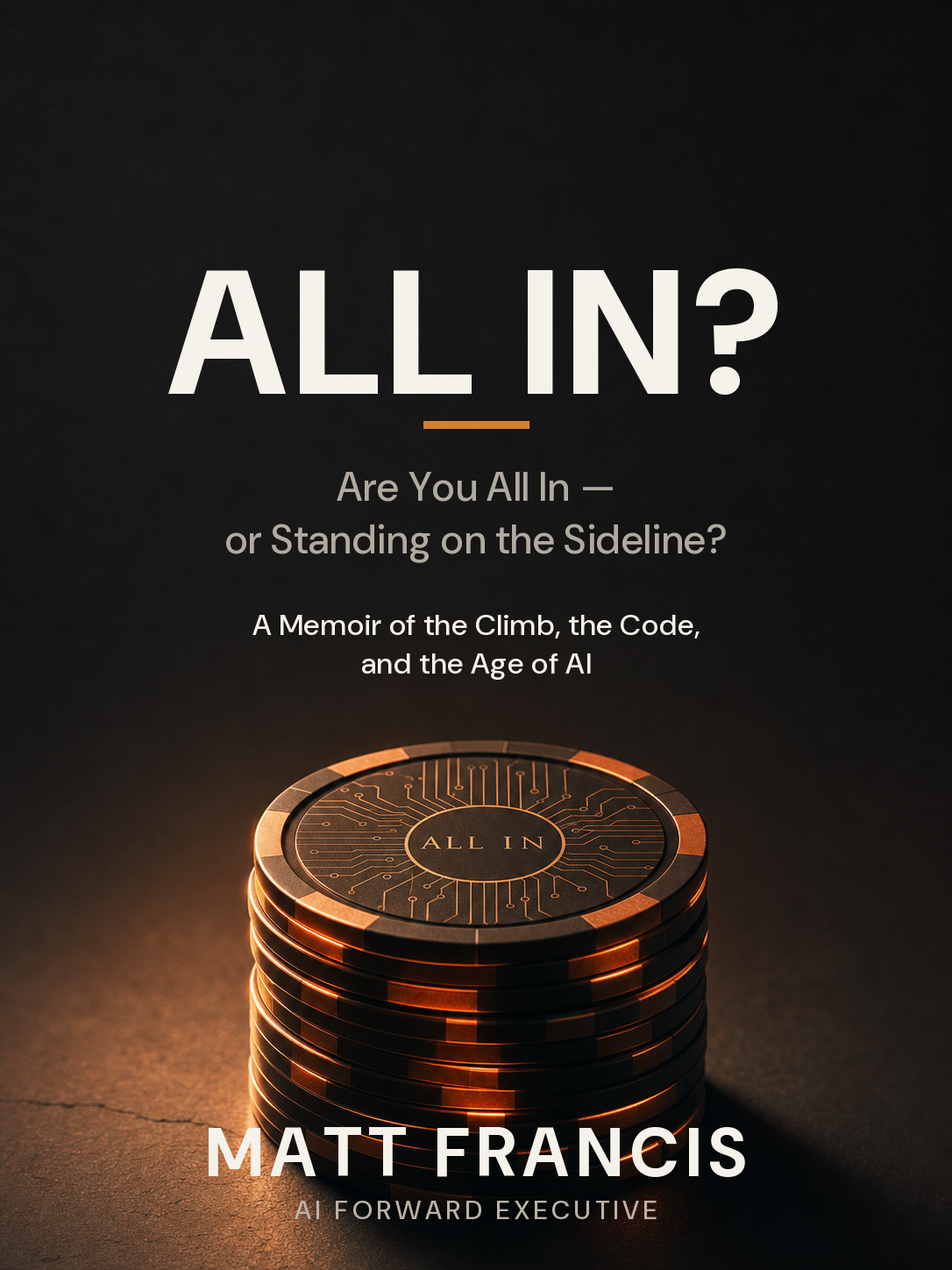
Are You All In?
"You eat, you sleep, you breathe, you dream, you want it. That's what it means to be all in."
Let me start with the question the whole book is named after, because everything else hangs off it. At every real turning point in a technology career — a platform shift, a new architecture, an AI wave that rewrites the rules while you're still reading them — there are two kinds of people. There are the people who go all in. And there are the people who stand on the sideline, arms crossed, waiting for certainty that is never, ever coming.
I have been both. I want to tell you what I learned standing in each spot.
I did not start in a boardroom. I started three pounds, twelve ounces, with about a five percent chance of making it, and I've thought of my whole life since as a bit of a privilege because of it. I grew up a latchkey kid in Georgia, biking everywhere, playing football in the street, taking apart hard drives to see what was inside. I flipped frozen patties at Burger King — and if you've never lifted a case of them, they are freaking heavy. I drove a forklift at Walmart. I got into West Point and then couldn't go. I lost my mother the year I was supposed to be celebrating.
I built my first real business at a satellite campus of Georgia Tech, consulting by day and taking classes at night, carried the whole way by a girlfriend who became my wife of twenty-four years. Then I spent about ten years as a developer, a database administrator, and a small-business owner — building one of the first content management platforms with e-commerce baked in, back when the web was still deciding what it wanted to be. From there I went deep on a single enterprise platform, not as someone who talked about it but as the person building it, object by object, flow by flow. That took me to owning the profit-and-loss for a global consulting practice, steering AI strategy for some of the largest enterprises on earth.
And today I've come full circle — a founder again, building Herd AI, one more time, from nothing. I tell you all of that not to impress you. I tell you so you know that I have stood on every rung of the ladder this book describes.
Technical depth isn't something you graduate from. It's the source of your leadership.
The Abstract Futurist
Books written by people who have never shipped a feature in their lives — all vision, no keyboard.
The Manual Writer
Dry implementation guides by people who've never sat in a boardroom where one wrong call costs millions.
The Hybrid
Fluent in both the code and the boardroom — the person who will define the next decade of business.
The most dangerous executive in the AI era is the one who has forgotten how the machine actually works. The most valuable one is the one who never let themselves forget.

The Plan That Fell Through
I was born three pounds, twelve ounces. It was 1976, and from what I was told, a baby that size had about a five percent chance of making it. My mother wasn't supposed to be able to have children at all. She called me her miracle.
My father was a computer engineer. He'd hold up one of those big flat-platter hard drives and tell me, with total confidence, "This is enough space to hold every program ever written. You will never need more space than this."
I think about that line all the time now. Every time someone tells me a limit is permanent, I hear my dad and that twenty-inch platter. Limits move. They always move.
That machine is where I learned DOS. It's where I first met the idea that a computer was something you configured, not just something you used. I got so into it that I wrote myself a little program to swap configurations depending on what I wanted to do — game here, work there. I didn't have a word for it then, but that was the first time I bent a system to my will instead of the other way around.
The Full Sample
Lilburn
I grew up in Lilburn, Georgia, out near the Stone Mountain area — an ordinary middle-class corner of Gwinnett County in the 1980s. We biked everywhere. We played in the creeks. We played football in the yard and, when we weren't being smart about it, in the street. We'd be gone for hours, sometimes what felt like days, and our parents genuinely did not know exactly where we were. And that was fine. That was normal. No social media. No internet. No cell phones.
We had VHS tapes. Later we had Blockbuster, with that felt-tip due date on the sleeve and the low-grade dread of a late fee if you forgot to rewind and return. We had bulletin board systems — BBSs — where, if you were patient and your modem cooperated, you could dial in over the phone line, download a game one agonizing minute at a time, and leave messages for people you'd never meet. That was the internet, before the internet. And I loved it.
The funny thing — and it's the first of many things in my life that turned out backwards from how it looked — is that my mother did not want me to go into technology. My father was a computer engineer. He'd bring his work home constantly. He'd leave those machines lying around and I'd get into them. I took them apart. Sometimes I got them back together and sometimes I very much did not. When I was finally old enough to have a computer of my own, I didn't buy one off a shelf — I ordered the parts one at a time and built it myself.
I wish, looking back, that I'd been more all in on computers right then. But I was in middle school, and I wasn't sure yet. I was curious — deeply, restlessly curious — but curiosity and commitment aren't the same thing. That's a distinction this whole book is going to keep circling back to. Curiosity is where it starts. All in is where it goes.
The Bottom Falling Out
Somewhere in the middle of middle school, my mother got sick. Both my parents worked, which in our house meant a very particular kind of childhood. I was a latchkey kid — I had my own key, I got off the bus to an empty house, made myself a snack, watched some shows, did my homework, and waited for the adults to come home.
My mother was one of the most independent people I've ever known. Before she was anyone's mom she'd been a bartender, a yoga and fitness instructor, an Army Reserve nurse who loved the work. There were two of her, it seemed — the fiercely independent woman and the kitchen-and-household mother — and watching them sit in the same person taught me something about how much bigger people are than the roles we file them under.
Then came the word cancer. It was a tumor on her kidney. They removed it, and afterward we faced the kind of decision no family should have to make. The margins were good, the doctor said. My mother didn't want chemotherapy and radiation. I did. But it was her body and her choice, and she chose no. Six months later it came back, in her bones. After that it was years — years of hospitals, years of pain, years of a house reorganizing itself around a slow emergency.
The medical bills did what medical bills do. My parents sold nearly everything. I came home from our old house to watch a life get liquidated in a driveway, and I did not understand it. I was thirteen, maybe fourteen, and the ground was simply gone. A church found us a place to stay, and I've never forgotten what it means when a community catches you before you hit the floor.
Here's what I did with it, and I'm not sure it was healthy, but it was mine: around thirteen or fourteen, I threw myself into work. My first job was Burger King. Everyone should work a job like that at least once. Something manual, something hard, something that leaves you sore. From Burger King I went to KFC, and from KFC to Walmart — which turned out to be my first real leadership education. I got to know every department. I got forklift certified. Eventually I had keys, and I learned what it feels like to be trusted with a whole operation and not just a task. Walmart also earned me the Competitive Edge scholarship — twenty thousand dollars toward college. That was not a line item. That was a door.
The Uniform
There's a military thread running through my family. So when I got to high school and a friend named Eric Adams pulled me into the Air Force Junior ROTC program, something clicked into place that I hadn't known was loose. I loved it. I joined the Naval Sea Cadets, stood on a submarine, flew in C-130s and Huey helicopters. I joined Civil Air Patrol and went on search-and-rescue exercises. Discipline. Service. Leadership.
And then there was Aviation Challenge, the fighter-pilot cousin of Space Camp. I went, I gave it everything I had, and I came home with the Top Gun and Leadership award. Because here's what all of it was quietly building toward: I was going to West Point. That was the plan. Congressman John Linder nominated me to the academies. I had the grades, the test scores, the extracurriculars stacked to the ceiling.
And I couldn't go. I have a high-frequency hearing issue. That was it. That was all it took. It disqualified me from the academies and from military service, full stop. It was devastating. When one plan dies loudly enough, it can drown out every quieter option standing right beside it. That's the first hard lesson of this chapter: a closed door is loud, and the open ones are quiet. You have to make yourself listen for them anyway.
January 1
I was still angry, and my mother was still dying. By my senior year, home was a place I mostly went to sleep. My mother was in and out of the hospital, in constant pain. My father was on disability after his stroke. I dealt with all of it the only way I knew how: I disappeared into school and work, because as long as I was running I didn't have to sit down and feel the whole weight of it.
My birthday is December 23rd. My mother wanted to make it to New Year's. She said January 1st. It was January 1st. I had been in the hospital with her for days. The doctor came in that morning and told us she was going to pass. I held her hand. I said goodbye.
The only two things my mother said she wanted to see were me graduate from high school, and — years later, though of course she never got to — my first daughter. When I did walk across that stage, it meant everything and it meant almost nothing at the same time, because the one person who'd asked for it wasn't in the seats. She was the most amazing person I've known. She loved everyone and everything, even when the world treated her like garbage. She just loved the world back anyway.
The School I'd Never Heard Of
A science teacher — one of those people who see something in you before you see it in yourself — asked me one day, Matt, have you heard of a Georgia Tech satellite school called Southern Tech? Absolutely not, I said. Never heard of it. You should apply. Put together an essay. Just apply.
What I do remember is what came back: essentially a full ride. Because my family had lost everything, I qualified for a Pell Grant. I picked up Rotary Club scholarships. I had the twenty thousand dollars from Walmart. It all stacked together into a full ride to Southern Tech — which became Southern Polytechnic halfway through my time there — taught by Georgia Tech professors who were every bit as hard as that sounds.
I started out in textile engineering and materials science, then switched to computer science and eventually earned my degree in Management Information Systems. Curiosity, again, doing what it does — refusing to let me settle into the wrong thing just because I'd already started walking down it. And I met a woman named Lindsay. We became real friends first, then genuine partners — the kind of partnership that has now lasted twenty-four years. She would go on to become Dr. Lindsay, a Doctor of Pharmacy, and my truest partner in every plan I've made since, including the ones that fell through. Especially those.
What the Broken Plans Were For
You cannot control what happens to you, or to the people you love. My mother's cancer didn't ask me. My father's stroke didn't ask me. A hearing test I couldn't study for erased a future I'd spent years earning. The world is messy. It is difficult. And it is beautiful — all at the same time. You don't get to pick which of those shows up. You only get to pick what you do next.
And what you do next is this: you find the peace, you find the beauty, you find the love. You stay accepting. You put in the time. You put in the effort. You stay curious about everything, always, because curiosity is the one engine that never runs out of road. And sometimes — when it counts, when you finally find the thing worth it — you have to be all in.
West Point closing wasn't the end of my story. It was the door quietly opening onto the one I was actually meant to walk through. The plans that fall through don't ruin the direction of your life. Sometimes, if you keep running, they are the direction.
Make a list of the plans in your life that fell through — the school, the job, the relationship, the version of yourself you were sure you'd become. Next to each one, write what it redirected you toward. You'll notice something: the doors that closed the loudest were almost always standing next to a quieter one you eventually walked through. Learn to listen for the quiet ones.
End of Sample
Thank you for reading the opening of All In? The complete memoir continues through twenty-one chapters — the climb, the code, and the age of AI. For the full manuscript, rights, or speaking inquiries, contact the author.
The Invitation
What you can control is whether you go all in on the things that matter — your craft, your people, your one shot at building something that lasts — or whether you stand on the sideline and let the moment pass. So carry one question from the first page to the last:
Are you all in — or are you standing on the sideline? Let's climb.